A Sarasota nonprofit’s immersive simulation compresses the first chaotic weeks after prison release into a single hour, revealing the obstacles many formerly incarcerated people face as they rebuild their lives.

By Kendall Southworth  June 8, 2026

Community leaders and curious citizens line up at different tables representing real-life institutions in an attempt to secure food, attend weekly treatments and counseling, pay restitution or student loans, and more.

Image: Courtesy Photo

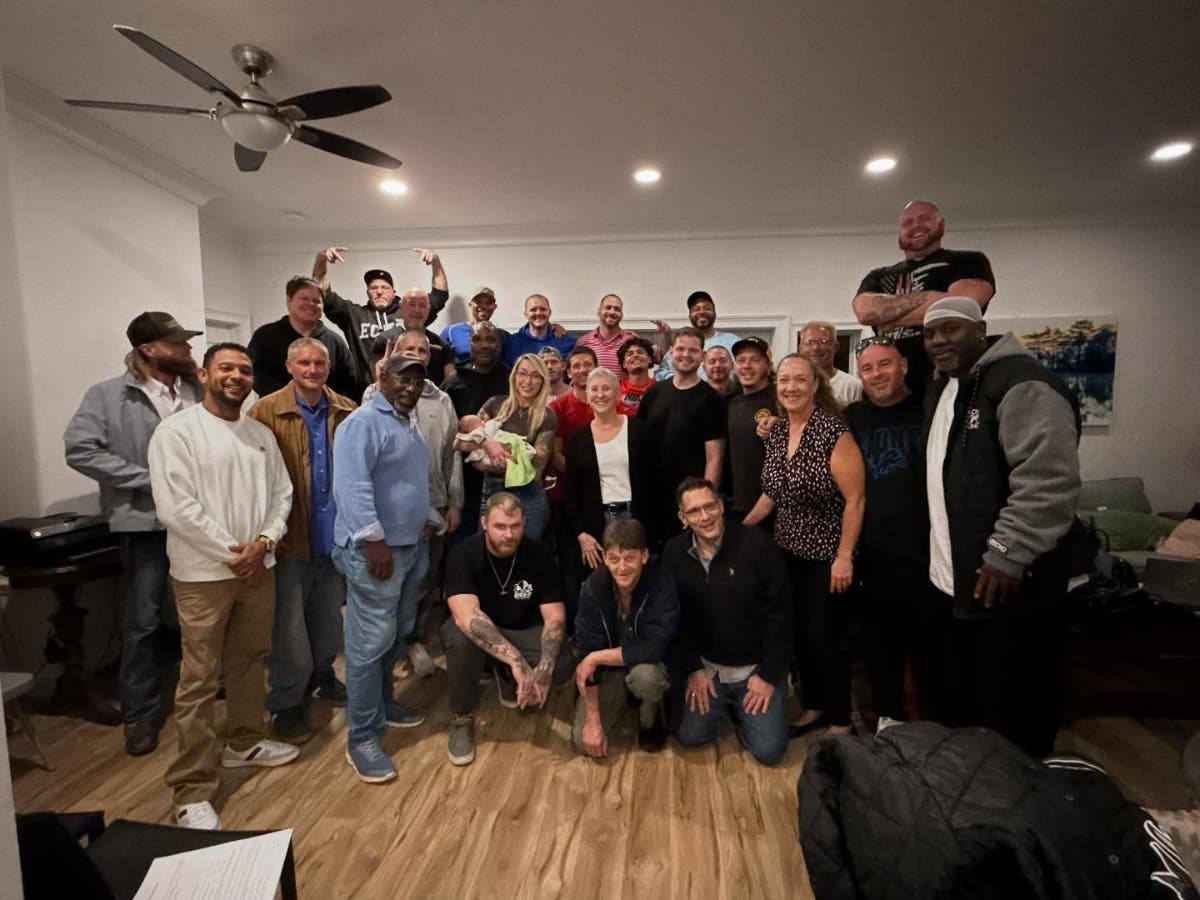
Last month, community leaders, landlords, lawyers and curious citizens found themselves scrambling before police officers and representatives from the Florida Department of Corrections, frantically digging through paperwork for identification, waiting in long lines to give blood, racing between churches and grocery stores and even stealing money from one another (monopoly money, that is).

The chaos intentional—and part of Project 180’s Reentry Simulation, an immersive exercise designed to compress the overwhelming first weeks after an individual’s release from prison into a single disorienting hour. Hosted by the Sarasota-based nonprofit, which focuses on helping formerly incarcerated individuals reintegrate into community life, the exercise assigned participants new identities and limited resources before sending them through a maze of responsibilities, institutions and unexpected setbacks individuals must confront immediately upon reentering society.

The simulation’s effectiveness was written across participants’ faces.

With the exception of a handful of those whose careers involved the reentry process—and two lucky volunteers guided through the experience by Project 180 staff—most participants were visibly frustrated within the first 15 minutes.

Among them was Manatee County Commissioner George Kruse. “It showed how broken the entire system is,” Kruse says. “It was physically impossible to actually complete what was necessary. You had to make tough decisions, and it almost felt like it was set up to fail.”
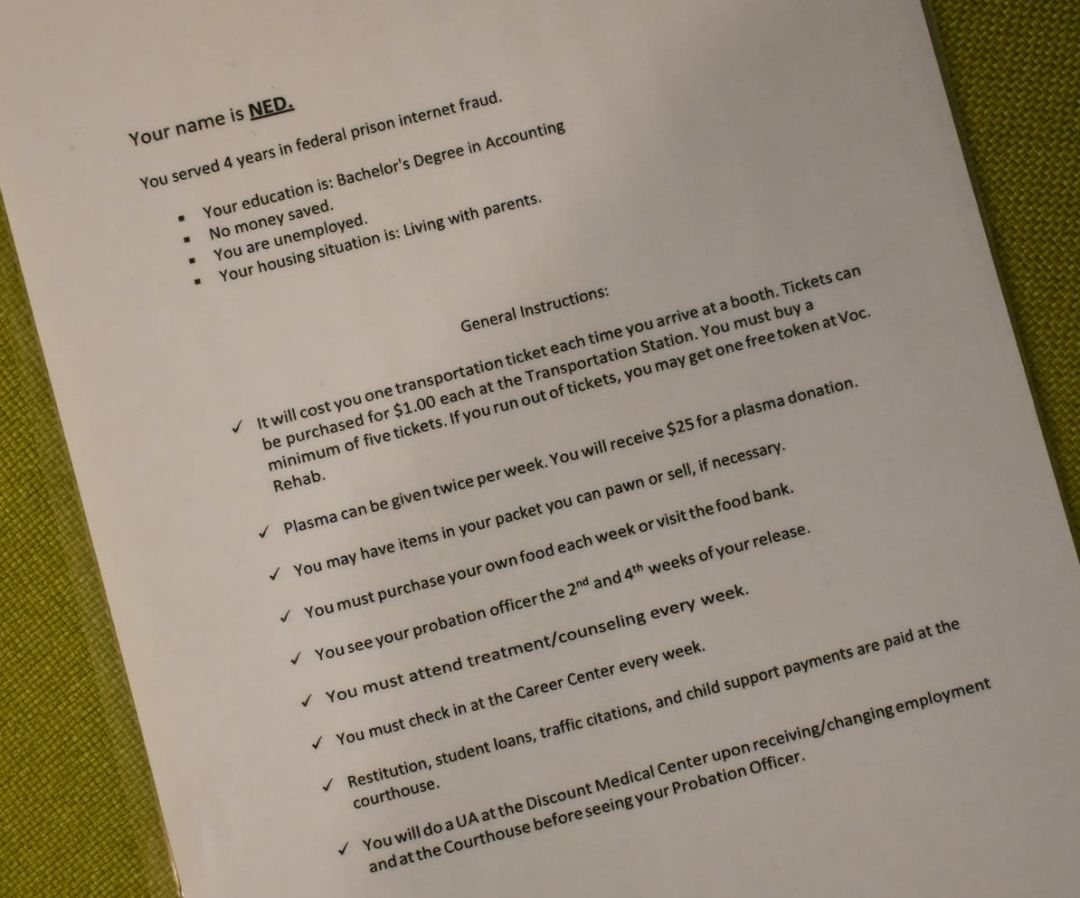
Each participant received a new identity featuring their background and general instructions.

The simulation reflects what advocates often describe as a “stacked burden”: not one obstacle, but many, arriving all at once, with each challenge dependent on successfully navigating the last. A missed appointment with a caseworker can mean losing eligibility for food stamps and other forms of assistance. A delayed paycheck can jeopardize housing. A lack of transportation can unravel both.

Each year, more than 30,000 people are released from Florida prisons and return to communities across the state. Many hope to become productive, law-abiding citizens but face significant barriers, including limited job skills, gaps in education and discrimination in housing and employment because of their criminal records.

Without support, many become statistics—the homeless, the unemployed, the undereducated and the impoverished. More than 76 percent are rearrested within five years, perpetuating cycles of victimization and straining community resources. Reducing those barriers is central to Project 180’s mission of decreasing poverty, homelessness and unemployment among formerly incarcerated individuals while improving public safety.

For Michelle Ace, an assistant public defender who participated in the simulation, the experience underscored how easily good intentions can be derailed by systemic barriers.

“It’s really frustrating when people are trying and the world comes down on them,” she says. “It’s easy to judge or be afraid of someone if you don’t understand them, but we have to have some graciousness and sympathy.”

Ron Solorzano, an Army veteran—known as “Uncle Ron” to the Project 180 folks—was grateful for the simulation, but didn’t want to participate. He already did, in real life, when he reentered society after serving twenty years in prison.

“When I got out, I was scared. I had no money,” he says. “I had lost everything. When I got out, they gave me $50, and that was that. I was working while I was incarcerated as part of the ‘farm squad’, farming produce for prisons all over, but there was nothing to report as earnings for Social Security. I had to start all over again.”

Officers stand guard at the “jail” for participants.

Project 180’s model combines recovery support with practical assistance such as food, clothing and transportation, introductions to employers, leadership training, volunteer opportunities and a new, law-abiding social network. With that support, Ron rebuilt his life. Today, he serves as a source of wisdom, accountability and stability for younger men navigating the same transition.

And Project 180 is working to extend its model to more people. Under the leadership of new president and CEO Antonia Rolle, the nonprofit is preparing to open its first residential program for women, aiming to replicate their reentry model while addressing the unique challenges women face when returning home and rebuilding their lives.

“This is the kind of thing that needs to get out more to the general public,” says Kruse, “and equally—or moreso—to the elected officials who have a say in it.”


Community Leaders Experience Life After Lockup Simulation | Sarasota Magazine

Project 180, serving Sarasota and DeSoto counties, is raising funds for its first-ever residential program for women leaving prison.

Project 180, serving Sarasota and DeSoto counties, is raising funds for its first-ever residential program for women leaving prison. The organization offers various programs for formerly incarcerated people.
Project 180, serving Sarasota and DeSoto counties, is raising funds for its first-ever residential program for women leaving prison. The organization offers various programs for formerly incarcerated people. (Courtesy of Project 180)

SARASOTA, FL — A Sarasota nonprofit dedicated to assisting formerly incarcerated people as they return to society is raising funds for its first-ever women’s residential home.

Project 180 already offers three men’s residential homes, as well as other co-ed programs, that help former felons to move their lives forward as they acclimate to life outside prison.

Now, the new home will offer women the same opportunity, Antonia Rolle, president and CEO, told Patch.

“People get out, and they have no resources. They try to do things the right way, but they can’t, and they do things the way they used to know how to do things, and then wind up back in jail,” she said.

The organization is seeking donations for the new women’s home. Any donations of $25 to $100 made between Wednesday at noon and Thursday at noon as part of the Community Foundation of Sarasota County’s 2026 Giving Challenge will be doubled.

The overall recidivism rate for those who return to prison after being released in Florida is more than 60 percent, while the recidivism rate for the more than 142 men who have gone through Project 180’s residential program since 2018 is 27 percent.

“We’re able to cut that in half for people who graduate from our program,” Rolle said.

The nonprofit was formed in 2008 by Barbara Richards. While her background is in hospitality — she worked for her family’s Greek restaurant in San Francisco and was manager of the Olive Garden in the Sarasota area — she was moved by a statistic that she heard while listening to a public radio station in California.

“She heard the statistic that for every Black man in college, there are five in prison,” Rolle said. “And for every Latino man in college there are three in prison. That just didn’t sit well with her.”

Richards went on to earn a master’s degree in criminology and when she moved to Sarasota, began hosting lectures and presentations on issues like mass incarceration and the experiences of former prisoners after their release.

“They get released at the craziest times on weekends, like at midnight, when no services are available, and we wonder why people get locked back up,” Rolle said.

For years, Richards built awareness of the issue, as well as a donor platform, before launching Project 180 in 2008.

The nonprofit’s early programs included First Week Out, which works with citizens from Sarasota and DeSoto counties who are scheduled to reenter before they even get out of prison. This program offers them a safety net and an advocate as they get ready to return home.

“Everyone doesn’t have a family to help them. We are literally meeting them at the bus stop,” Rolle said. “We take them for a haircut, a meal. We get them clothes and two forms of ID. We help them with finding jobs and learning how to live.”

She added, “Our goal is to really, truly let people have second chances. We’re really good at incarceration in this country, but not so good at rehabilitation. And there are hundreds returning to [Sarasota] County each year, whether we’re ready for them or not.”

Project 180 also offers a financial literacy course for returning citizens, as well as a workforce education program that brings CEOs and hiring managers into prisons to work with those who are pending release.

The organization’s first men’s residential home opened in 2018. Today, the nonprofit offers three homes for men.

Each home, all in the Sarasota Springs area, houses up to six men, where they are provided food and the funds to pay for things like medical and dental care, and restoring their driver’s licenses.

“They plan meals together like a family. There is such a brotherhood in the house,” Rolle said.

The homes offer them up to two years of stable residency, though, on average, most live there for about one year as they get back on their feet.

Even after they leave the homes, many of the men who graduated from the program still participate in it, returning for weekly meetings.

“They’re invested in it, and they serve as role models for the guys in the house now,” she said. “It’s definitely like a brotherhood, and we’re hoping to create that same thing, but with women.”

For many women who are incarcerated, “their run-ins with the law” go hand-in-hand with addiction, Rolle noted.

While rehabilitation facilities focus on getting people clean, they often stop there.

“They have a place to get clean, but that’s it. And then what? How do you learn to live a whole different type of life?” she said. “We’ve found it’s not just about stopping addiction; it’s about creating a different way to live. If you went right into addiction in your teen years, when did you learn to be an adult? A lot of people leave rehab facilities not quite ready to go out and do it on their own yet.”

In addition to the women’s residential program, Project 180 has also set its sights on social enterprise. Through a recent grant, the nonprofit plans to launch a food truck this year called the Comeback Kitchen, to allow formerly incarcerated people to have hands-on work experience.

“It will be a place for us to do workforce development and teach entrepreneurship skills,” Rolle said. “A lot of people are good at their trade, but they don’t know how to run a business. There are places that teach these skills, but there’s something to be said about hands-on experience. This will be boots on the ground doing it, and we’ll do it in a way so it doesn’t seem like a big scary thing.”

Residential Program For Formerly Incarcerated Women To Open In Sarasota County | Sarasota, FL Patch


Sarasota, FL. Project 180, a prisoner reentry nonprofit headquartered in Sarasota, is pleased to announce the appointment of Antonia ‘Toni’ Rolle as President and Chief Executive Officer of the organization. Ms. Rolle began her tenure on August 4, 2025.


“We are thrilled to welcome Toni as Project 180’s new leader,” said David Shuel, Board Chair. “She brings a team-building focus, collaborative management style, and in-depth knowledge of data integrity and scalability. Her technical skills and her passion for the welfare of our residents and program participants are an ideal combination to pursue and expand Project 180’s mission of reintegrating formerly incarcerated citizens into community life.”


Toni comes to Project 180 from our partner, Goodwill Manasota. As Director of Mission Services there, she gained years of both corporate and hands-on experience serving vulnerable populations. While managing the Good Partner Coach Program, Toni developed partnerships on both Florida coasts with employers willing to hire, among others, individuals with criminal backgrounds who had little conventional job experience and hailed from families that had experienced multi-generational poverty, a perfect fit for Project 180.


Toni is proud of her history of working with people from diverse backgrounds. She writes, “I see myself as a bridge between those making decisions and those about whom decisions are made; bringing each group to the fulcrum where understanding and collaboration happen is exciting and inspiring. I’m excited to utilize those skills to continue Project 180’s tradition of being a bridge of understanding between those who have and those who have never been incarcerated.”

“Growing up and in my professional life, there has always been someone who saw more in me than I could see in myself. I want to be that person for Project 180 residents and participants to help them optimize their potential. They have so much to offer our community.”


For more information or media inquiries, please contact:

Antonia Rolle, President and CEO

Project 180

antonia@project180reentry.org

Phone: 941-780-5227


About Project 180:

Project 180 is a Sarasota-based prisoner reentry nonprofit that helps men and women succeed during the difficult transition from prison or jail back into the community. By helping people rebuild their lives and become productive citizens the organization also helps the community at large. Since 2018, its Residential Program alone has prevented over 92,000 crimes. Project 180 is the recipient of the Florida Council on Crime and Delinquency’s 2024 Reentry Award and the subject of a documentary film, “The Light They Cast.”

Published: 10/6/2025

Sarasota Herald-Tribune

September 8, 2025

Written by: Antonia Rolle

Guest columnist


Imagine someone walking out of jail or prison with a small bag of belongings, unsure where they will sleep that night.

Or how they will get to a job interview.

Or how they call a probation office for their mandatory check-in.

Even when they are ready and willing to do the right thing, many ex-offenders face major barriers, including finding employers willing to hire someone with a criminal record.

To address these barriers to successful reentry, Project 180 works directly with currently and formerly incarcerated men and women to assist them in their reintegration back into Sarasota County.

Our nonprofit partners with the Sarasota County Sheriff’s Office by offering a financial literacy course and a CEO program which connects incarcerated students with business leaders, hiring managers and workforce development professionals to prepare for meaningful employment upon release.

Since 9 out of 10 people with a criminal record have been victims of a crime, we also provide a healing trauma education class taught by Kathryn Greenberg and generously funded by the Gulf Coast Community Foundation.

In partnership with the Florida Department of Corrections, Project 180 operates a First Week Out Program to assist individuals returning from state prison to Sarasota County.

Our organization prevents homelessness and reduces reincarceration by providing cellphones, clothing, transportation and introductions to Second Chance employers and program houses.

Beyond classes and advocacy, Project 180 provides housing. Its residential program gives men the opportunity to live in small, supportive households where peer connection, accountability and structure create a family-like environment.

One resident who embodies the impact of Project 180’s programs is Britt. (pictured below)

A star athlete in high school who grew up in Newtown, Britt drew the attention of numerous college recruiters; however, his academic challenges precluded a collegiate future.

Instead of college, Britt turned to selling drugs after graduation, which led to a cycle of incarceration and addiction. As his addiction took hold, his shame caused him to avoid anyone who had known the person he once was.


Britt knew he needed to change, so he entered Project 180’s residential program and embraced it fully.

He graduated from the residential program after two years of engaging in the community, reuniting with family and discovering a sense of purpose.


Today Britt participates in Project 180 events, is a mentor for current residents and embraces the opportunity to help others see a path away from the choices he once made.

Transformation is possible.

Far from a handout, Project 180 is an investment in the safety and strength of our communities; it helps people reach their potential.

The support it provides for returning citizens reduces recidivism, empowers people to reconnect with their families and builds stronger, safer communities.

When reentering citizens are met with compassion, structure and opportunity, lives are transformed.

Every job secured, every safe home found and every step toward recovery is a victory for both the individual and Sarasota County.

As Project 180 looks to expand its residential services to women, Charles & Margery Barancik Foundation will be assisting with strategic planning and community conversations to ensure the right support is provided.

By investing in programs like Project 180, people receive a chance to reclaim their lives, restore their families and become forces for good.

Antonia Rolle is the CEO of Project 180 in Sarasota. Email: Antonia@project180reentry.org.


Born and raised in Massachusetts, Hank spent more than ten years in a wide range of environmental law enforcement, supervisory natural resource protection, emergency hazardous waste contingency response and white-collar crime investigation with the U.S. Department of the Interior, National Park Service and the United States Secret Service.

Hank received his:

  • Bachelor of Science degree from the University of Massachusetts at Amherst with a concentration in Natural Resources Law Enforcement
  • a Masters in Criminal Justice Administration from Boston University
  • a Master of Arts in Holistic Counseling and a Master of Arts in Holistic Leadership from Salve Regina University
  • two certificates of advanced graduate study in Holistic Counseling and Holistic Leadership
  • two certificates of advanced graduate study in Counseling
  • a Doctorate in Educational Administration & Leadership from Seton Hall University

He is a graduate of

  • the Assisi Institute’s Two-Year Archetypal Pattern Analyst Program
  • and Air University, Air Command and Staff College

In addition, Dr. Brightman is

  • certified clinical hypnotherapist
  • certified clinical trauma professional
  • and certified personal trainer through the Aerobics & Fitness Association of America

Hank is currently a full professor and Acting Director of the Civilian-Military Humanitarian Response Program within the College of Maritime Operational at the United States Naval War College. He also serves as the distinguished EMC Informationist Chair (an eight-year, endowed appointment). From 2008-2016, he served as an Associate Professor, Professor, and Director of Applied Research & Analysis in the War Gaming Department of this institution.

From 2000-2008, he served as a tenured Associate Professor and Chair of the Criminal Justice Department at Saint Peter’s University, and also serves as an adjunct faculty member at Salve Regina University, Saint Peter’s University, and Utica College, where he teaches a wide range of undergraduate and graduate-level courses in Criminology and research methods.

In his Navy Reserve career, Commander (CDR) Heath “Hank” Brightman serves as Commanding Officer of Navy Reserve, Cryptologic Warfare Group in Massachusetts. A fully qualified Navy Reserve Cryptologic Warfare Officer, CDR Brightman’s most recent active duty mobilization was from March 2018 through February 2019, assigned to the Office of Military Commissions, Military Commissions Defense Organization (Washington DC/Guantanamo Bay, Cuba). In this capacity, he served as the Senior Intelligence Investigator on a 9/11 high-value detainee case team.

For the past seven years, Dr. Brightman has maintained a part-time, private trauma and wellness practice in Newport, Rhode Island, focused on applying a variety of holistic techniques to support client recovery. His primary approach combines Jungian, Gestalt, narrative, and expressive therapies with clinical hypnotherapy, physical fitness, and nutrition.

Sheriff Kurt A. Hoffman is the 11th Sheriff of Sarasota County and began this new leg of his long service to our community earlier this year.

Sheriff Hoffman began his law enforcement career as a deputy with the Charlotte County Sheriff’s Office in 1989. He served the Sarasota, Manatee, and DeSoto communities for more than three decades as both a prosecutor and as the general counsel for the Sarasota County Sheriff’s Office since 2005. During his tenure, he was promoted to Captain, Major, and Colonel prior to winning the 2020 election to become our new Sheriff.

Sheriff Hoffman has a rich family history of service in both local and state law enforcement as well as the US Military. He has a passion for the veteran community, his family, and his hometown. He and his wife Teri reside in Venice.

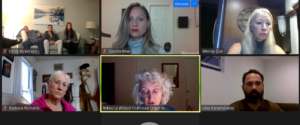
Project 180 residents had the opportunity to sit down for a virtual meeting with three attorneys who were eager to answer their questions and offer support for what is oftentimes a stressful and confusing task: filing taxes.

Gulfcoast Legal Services, a non-profit organization that provides high quality legal services at no cost to the client, gave a detailed presentation Monday evening about how to properly file annual taxes and answered questions during a group discussion with Project 180 residents.

“I think perhaps the most important thing that happened [tonight] is that these guys now have a personal relationship with 3 tax lawyers,” said Wendy Cox, tax attorney for Gulf Coast Legal Services who led the workshop.

The workshop addressed vital information and explained how to properly fill out a W-4, how to receive a stimulus check, where to file taxes at no charge and so much more.

“I think the key will be if they contact us for 1:1 advice.  That’s where we can really help people,” Wendy added.

Gulf Coast Legal Services kicked-off Project 180’s first Resident Workshop that was designed to bring industry experts and professionals once-a-month to help educate Project 180 residents on a broad spectrum of topics.

If you or your organization would like to provide a workshop for Project 180 residents, please email Sandra.project180@gmail.com.

“We can’t thank Wendy and her team at Gulfcoast Legal Services enough for sharing their time and knowledge with our residents,” said Barbara Richards, Project 180 Founder and CEO. “Our residents had several questions about their taxes and they were relieved to have answers from trusted professionals who want to see them succeed.”